Tuesday, 30 March 2010

Rome Sweet Rome: The return of the Van


written 24th March

I am so glad we decided to have an easy day yesterday and not try and rush into Rome from St Felice.  Instead we spent the day vaguely looking for somewhere to do washing (failed) and the evening at the Lido watching the hookers whilst we cooked dinner - well we were there first! and it was fascinating, more for the behaviour of the traffic than the ladies of the night though... - before finding a parking spot well away from whore-central and near the train station.

BTW, in case you were wondering, Carrefour.it, somewhat similar to Carrefour.fr except the muesli comes in much smaller packets for the same price - they don't really do breakfast cereal here we are finding - and the easer bunny in france must be the size of an actual elephant.  who needs a 10kg chocolate egg and who can afford it at €99???

anyhoo, off to the Vatican, bright and early.

The Vatican is the smallest independent sovereign state and is ruled by Europe's only absolute Monarch, in the form of the Pope.  Although it has just 500 residents, it has its own judicial system, post office, banks, currency, radio station and newspaper (printed in every tourist language conceivable so you to can read what the pope reads!).  It is believed to be sited on the grave of St Peter, whom the catholic church deems to be the first Pope, by which they mean God's chosen representative on earth, a leader who is subject only to God.

The rise to power of the Catholic church began in 312 AD when the emperor of the time, Constantine, converted to Christianity.  The roman empire began to fall under attacks from the germanic invaders from the north and the Pope enlisted help from Charlemagne of France, later crowned Emperor of Rome, to try and defeat them.  Although somewhat victorious, this however only led to power struggles between the Pope and the Emperor which continued for centuries and left Italy open for feudal lords in many regions to successfully assert their independence.  Eventually, as had been discussed elsewhere, Italy was finally unified by Vittorio Emanuele II and in 1929, Mussolini begrudgingly granted the Pope sovereignty over his tiny kingdom. 

Outside, there are no visible signs that you have passed from Rome in to The Vatican but stepping into the Vatican Museum was like walking into a busy airport terminal.  Echo-y spaces, high ceilings, criss-crossing escalators, marble staircases, bag x-rays, body scanners, monitors telling you which galleries were closed and people milling about everywhere.  Having by chance, coincided our visit with the day and time of the weekly papal audience, once we found our way through the throng and up the stairs, there wasn't a queue for tickets and in we went.

Having been warned by every guidebook that the museum is vast - with good reason! - we headed first to the Sistine Chapel so as not to end up there with museum fatigue and just wow.

wow.


again, have seen some pictures in the guidebook but nothing prepares you for the vastness and colours and dimensionality of the thing.  The pictures round the sides are good and all but enormous figures on the ceiling just seem to be about to leap out and down at you.  Just amazing!

Phototaking is forbidden but here are some inadequate contraband to give you the vaguest, vaguest idea.  You do, absolutely, if you haven't already, have to go yourself.


We managed to get a seat around the edge so spent about an hour in there, just taking it all in and listening to the audio guide, which was interesting, but not as good as the guided tour we managed to tag ourselves onto outside in the courtyard of the pinecone later on - there is also supposed to be no talking in there so to give the guides something to talk people throuhg, there are lots of picture boards out in the courtyard where they head first to do their spiel - which is a nice idea.  To be completely honest, some of that time was spent trying to remember the name of the fourth Teenage Mutant Hero Turtle (Leonardo btw) - well you can't always keep your mind on higher things...

Anyway.  It was Pope Julius II, who also started the rebuilding of the Basilica of St Peter into it's current form, who kicked off the redecoration of the Sistine Chapel.

The frescos on the sides, by people such as Botticelli and Perugino, and which show the parallel lives of Jesus and Moses were already on the side walls, with the Popes between the windows, and he decided that the ceiling, which was at that time just stars was not grand enough and wanted the 12 Apostles up there.


He had a reputation for being an exacting task master and a difficult man and was already not in the best of health so wanted the job done quickly.  The Sistine Chapel is apparently the same dimensions as the Temple of Soloman and the ceiling is vast.  His experts estimated that the job would take the artist and 12 assistants 15 years to complete it.


Not surprisingly, the big names of the day, Raphael, Botticelli et al, who were approached were not keen, believing it would be difficult, take ages when they could be working more profitably elsewhere and that it wouldn't enhance their CV much.  However, there was a young upstart sculptor in town, fresh off the cart from Florence who was going around making waves and who, in Raphael's opinion, needed taking down a peg or two.  Thus it was, that Michelangelo, a 24-year-old newcomer with no fresco, or even painting, experience was appointed for the job.  Apparently he spent time with the assistants learning fresco techniques and then fired the lot, setting out to do his first Apostle, St Peter, alone.  It didn't get off to an auspicious start as on his retunr the next day, it had all fallen off the ceiling and shattered on the ground.  He ran away to Florence hoping to hide.  But if the Pope wants you to do something, do it you shall or die in the doing so he was dragged kicking and screaming back to Rome, by the silly suited Swiss Guard - serious, what is going on with that uniform!.  His last ditch attempt to get out of it was to try and set some ridiculous ground rules that he believed the Pope would not countenance.  So he said he would do it on three conditions:

He could paint what he liked

None one could come in whilst he was working or see it before it was finished

Once it was finished, he would not change a thing, in fact, he would go away and never paint again.

Thinking that would be an end to it, he was dismayed when the Pope agreed to all three, and locked himself alone in the vast space - something like 30m by 40m by 22m high or some such dimensions - where he did his own designs, mixed his own paints and built his own scafolding.

He finished the masterpiece we see today in a mere four years so Pope Julius II did indeed get to see it before his death a couple of years later, although apprently all he said was that he felt the figures looked too poor and they should have more gold on them.  Michaelangelo countered that we all are born with nothing and die with nothing so how can he paint people with such riches, and anyway, he wasn't going to change anything.  So the Pope couldn't really argue.

and just wow. 


It has been restored in recent years so the colours are back to what they apparently were, before years of grime and candle and incense smoke sullied them and really, wow.


After his abortive attempt at apostles, and as an educated and religious man, Michaelangelo decided he instead wanted to tackel the subject of the Fall of Man - a little bit of light entertainment then!

The nine panels in the centre of the ceiling are therefore divided into three groups showing;

God Dividing light from Darkness, The creation of the Sun and Moon, The Dividing of the Waters and the Land

The Creation of Adam (that famous finger touch!), The Creation of Eve, Original Sin

The Sacrifice of Noah, The Flood, The Drunkeness of Noah - and therefore Man's inextricable fall into the binds of sin

As I say, cheery stuff!

Down the sides are images of the Ancestors of Christ - to show his place and importance throughout history - some of the Prophets and the Sybyls, whilst in the corners are Old Testament scenes of salvation, such as Moses and the Bronze Serpent and David and Goliath.

Just wow

The other big masterpiece is of course Michaelangelo's Last Judgement, painted at the other end of his career when he was in his 70's or 80's and which takes up the whole of the end wall.  Working alone once more, although this time not continuously, the subject matter is again the consequences of Man's sin, this time showing Jesus, with Mary at his side, and surrounded by saints, instructing the angels to raise the righteous to heaven and cast the sinners to the city of the damned by way of the boat over the river Styx - once I finish the Iliad I will be looking for Dante's inferno methinks!


The work was revolutionary as it showed angels without wings, saints without halos, grotesquely deformed condemned sinners and lots of nakedness - so much so that one of the cardinals, who saw it before it was finished when he should have looked, made a complaint.  He apparently appears in the fresco, at the bootom right-hand corner, wrapped by a serpent and condemned to hell for ever - nice one!  There is apparently also a self portrait of the artist in there, as the face on the skin held by St Bartholomew in commemoration of the fact that he was martyred by being flayed alive.  Not where I would have put myself but there we go.

The work took 8 years to complete this time but Michaelangelo refused payment as he believed that the papacy of the time was too rich and too obsessed by money and he wanted his fresco to show them the error of their ways.  Surely a better point would have been made by taking lots of their money for it and giving it away but who am I to argue.

Out then, at last, and on past hall after painted hall of 'stuff'.


After some lunch we had brought - partly we have learnt from our several, previous attemtps  the folly of seeing eminent things without lunch, but mainly because we had some left over from yesterday than any actual planning... - we headed back into the warren of the museum - if you want any sort of guide you have to buy it and "map" they give you with the audio guide merely tells you the numbers of the main attractions with a vague indication of in what order you might find them - you end up walking in circles a lot.


The Vatican Museum is not just about religious art commissioned by Popes, it is also a repositary of all sorts of significant finds, archeology of different civilisations with the general principal that all art is inspired by God, whether it is christian, pagan or otherwise.  Absolutely nothing to do with acquiring great wealth through objects, not at all....

Anyway, we saw Egyptian Tombs, complete with mummies, urns to put their internal organs in and little clay figurines to do the chores assigned to them in the afterlife - bit like fantasia I imagine...,

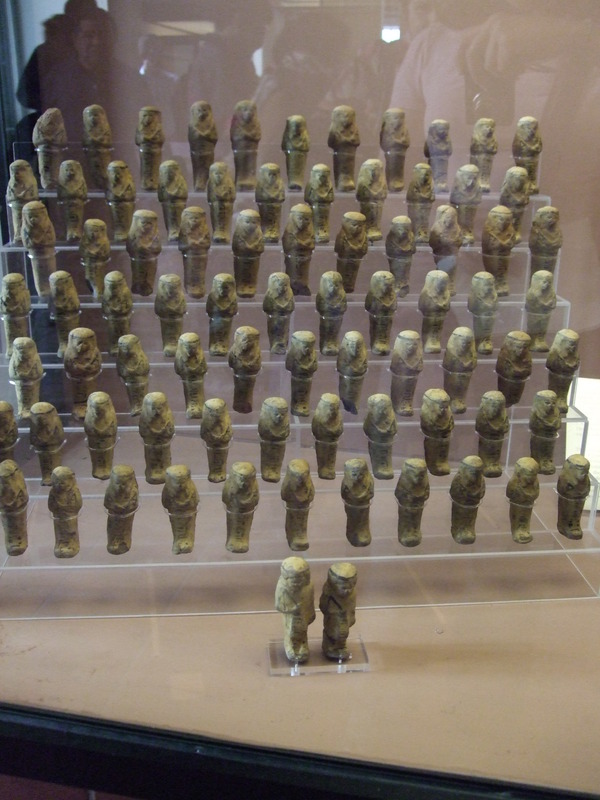


Roman Art, Ancient maps, Tapestries, art, more art and endless corridors with painted ceilings.


We eventually made our way to the Raphael rooms - the other 'must see' apparently - which is a suite of rooms commissioned by Julius II when he ascended to the Papacy because he didn't want to use the rooms of his hated predecessor.

There are four main rooms, which were already fresco'd by leading names of the day but he ordered them all removed and for Raphael to re-paint them. 
Being also commissioned to work on the new Basilica, Raphael only had time to do one of the rooms himself and only supervised the others.

His room, the Sengatura, explores the theme of truth, both through Theology and Philosophical discussion and to be honest, whilst i know he was good, he was probably right that the Sistine Chapel would not augment his CV as they just aren't in anyway as good as Michaelangelo's...


The Constantine room


and the Room of the Fire at the Bourgo represent those particular topics - nice to keep things simple! - and were not done by him.  So there you go.  Still quite impressive though.


And just to round the day off, some modern art to counter the old stuff - some of it just a bit random...


The prescribed route took us inescapably back through the Sistine Chapel, where we found that we had definately done the right thing in getting there early.  Although less crowded by this point in the day, it is seemingly only lit by the natural light which comes in through the big windows so in the morning sunshine, the colours had been brilliant, whereas in the dull, clouded over light of late afternoon, it was all somewhat drab and much less impressive.  So there you go, if you do go, and I really, really think you should, a) don't assume it is a good indoor thing on a dull or rainy day and b) go in the morning whilst the light is brightest, short cut to the chapel and then go round again.

A bit museum'd out by this point, we headed to the Basilica where we found we were just in time to go up to top, but only by the taking the lift (and therefore only having to climb 320 steps) rather than by the cheaper (and therefore prefered!) stairs option (a mere 525 steps...).  Still, there are a lot of other towers and domes we haven't climbed to date and there won't be another Duomo in Vatican City rooftop climb on this trip so up we went. 


The lift pops you out at the level of the bottom of the dome


for a view down into the vast trancept and it is amazing.  Just huge.  Apparently the letters round the edge here are over 6ft tall.  They don't look it, even from here, just goes to show.
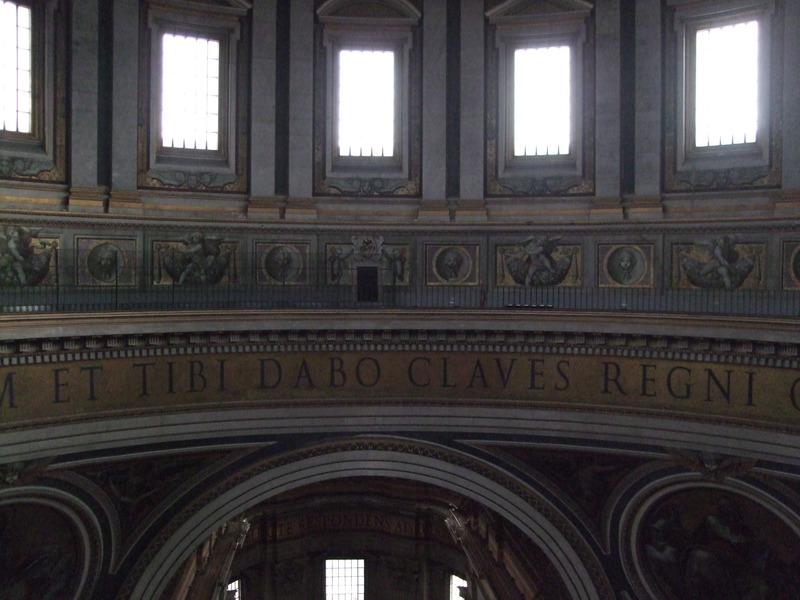


The way up starts as a gentle slope, then turns into a dizzying series of ever narrowing spiral stairs and finally a slanted passageway sandwiched between the inner and outer skin of the dome itself.  It is a bit epic.  Still, the quest for fitness has definately paid off.  I got up all 320 without stopping (although I still need to work on the feeling-like-I-am-going-to-die) and Will is more mountain goat like than ever - hurrah for us!


The view over the city, in the setting sun was fabulous.  All the big sites, Vittore Emanuele II monument, Forum and Colloseum all clearly visible, as well as down into the Vatican and the gardens.


Down again then and into the Basilica which is even more huge looking up than it is looking down.


The altar end is just fantastic


and all around are niches and statues,


including Michaelangelo's Pieta, tucked away behind glass in a dark corner, the sculputre he created aged just 25.


The tomb of St Peter is in the middle


and there are also some effigies of popes, looking just too much like dead father christmas's to be taken seriously


and all manner of other marble creations, including marble effect speakers - nice touch!

  Just immense.


and out once more, past the Swiss Guard with their clearly ridiculous coloured uniformed,


complete with leg streamers - yes, they are not just trousers, the blue and orange bits are free-moving streamers over the red trousers beneath!  very, very special -


and unexpectedly, a complete orchestra and people with hankies doing interpretive dance - whatever takes your fancy I suppose


So Rome: Done

Onwards and upwards once more then, en route to the frozen north...

Saturday, 27 March 2010

Up to heaven and back in time


written 22nd March

Arriving just after dark, in a never-ending queue of rush hour traffic, Sorrento did not, at first, appear to be very van friendly so we pressed on the Massa Lorense, which didn't seem much better.  However, a quest for petrol and an attempt at finding an aire, took us back to Sorrento where we found one but not the other, and quite by chance, the only unmetered parking bays in town.  Brilliant.

And the next morning the sun was shining as we set off into tourist city in search of coffee and a bun for breakfast.  even better

As the biggest and most well known of the towns on the northern side of the peninsular which bears its name, Sorrento is a tourist town and proud of it.  Built right to the edge of the sheer cliffs which jut out into the bay of Naples, as well as being a destination in its own right, it is also a jump off point for the beautiful Amalfi coast and jet set Capri.  And in the brightly shining saturday morning sunshine it was rather lovely.


We wandered into town, past the horrifically expensive cafes in the main square and into the typical streets.  We were just despairing of finding coffee anywhere for less than €2 a cup, let alone a bun, when Will spotted a barely signed, dark doorway with a throng of chattering locals where €3.50 got us coffee and delicious buns - so tourist tax is 150%!


We wandered to the Marina Piccolo


and whiled away some time watching the dinky cars pootle round below us, in particular the logistical shuffling of the long-stay managed parking and the random swerve and stop manoeuvre which constituted parking outside the carpark - much less dull than it sounds honestly!


Back into town and a further stroll took us to the Marina Grande through the typical streets where we found tourist tat of all types, including:


Talking teatowels ("look at me!"),


 Curiously shaped hanging cheeses (we later found, by buying some in a supermarket, that is it so you can smoke it - yummy)


 Brightly coloured tourist pasta, including some of unmentionable shapes - look very closely...


The biggest lemons I have ever seen


 As well as lemon soaps, lemon liqueurs, lemon sweets, lemon ceramics and anything else you can possibly imagine you can do with either a lemon or an image of a lemon


And most disturbing of all, holographic dying Jesus pictures where not only did the eyes follow you as you walked past, they also opened and closed (or winked if you stood in the right place) - just too creepy!


 Having had our fill of tourist tat - lovely though it was - and deciding against a trip to Capri - would have to leave Jules behind even though it was very, very tempting to see just what the parking attendant guys would make of it... - we headed on up and out.  Heading away from the usual tourist trail straight over the top to Positano, we headed back through Massa and after several sweeping curves and little villages, ended up at Termini where we spotted a sign for a Punto Panoramico - sounded just perfect for a late lunch stop.  No real carpark and a suddenly narrowing road led to a 16 point turn in the road using forward and reverse gears and a nose-in-the-cliff swerve and stop parking approach (like all the other local cars!) where we left Jules, in gear, with the handbrake on and a wheel choc or two - it was that sort of road - and headed off.


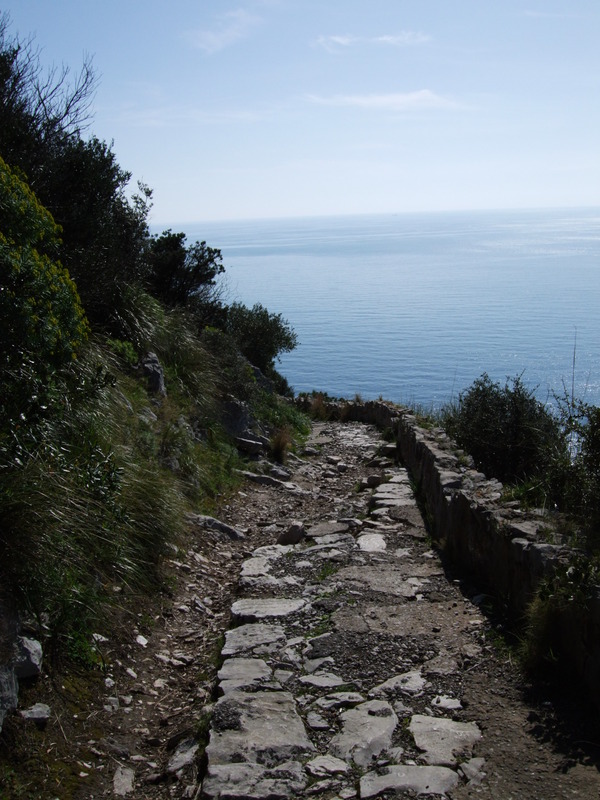
The path was glorious, at first winding along the contours of the olive terraces, then sweeping down towards the sea,


with Capri always to the right of us floating in the blue haze.  It was perfectly sunny and still, with the only sounds being our footsteps on the path, the gentle swich of the sea, the chirriping crickets and occasional bird song, and the busy buzz of rustic chainsaws - it apparently being olive prusning season.  bliss


We eventually found the 'point' and had our picnic in the gloriously warm sunshine before heading back up and off again.


 Next stop planned was Positano, the start of the famous Amalfi coast drive, likened to heaven by all sorts of eminent literary figures.


Sadly, initial appreciation of the road was marred by once again running out of petrol, like seriously, off the bottom of the gague on a hilly, single carriageway coast road with hairpin corners and not enough stopping places, where the towns cling to the side of the near vertical cliff and entry into them in a van, no matter how little, just does not seem like it will end well...  Our problem is caused by the shocking price of petrol here - the most expensive of the trip so far and we thought south of france was bad - and the seeming complete lack of price sensitivity here - again even worse than in France or Spain.  This means that you can see petrol at €1.449 in one place then 500 metres down the road at €1.389 and there will still be people at the first place filling up.  Just wouldn't happen in the UK.  We have even seen petrol stations of the same chain, on opposite sides of the road with different prices, and again, as many people in the expensive side as the cheap side.  Just unfathomable.  Makes a differnece of a 50l tank too! What this means therefore, is that we are always looking at petrol prices, just to get a feel for what is the average and spread in a locality and if it is expensive but we have no choice, we just put €10 in at a time.  This also means we are on the verge of running out a lot. 

 We have also learnt that, whereas in france, if you ask someone how far away something is, the answer is always '5mins away', regardless of actual distance, prevailing traffic conditions or actual likely time it will take to drive there (as all their Carrefour adverts have a time in minutes on them, we have studied this phenomena, actual time can be anything from a factor of 2-5 times quoted time), if you ask in Italy, the answer is always 2km.  Space and time in europe are clearly somewhat more elastic than we are used to.  We have come to the conclusion that it just means 'too far to walk'. 

 But somehow Jules just keeps going and after a tense 20 mins of so, with Will coasting at every available opportunity - which scares me as it seems all the time like the engine is just cutting out and all is lost! - we did find the place the wizened little old man had indicated.  €1.468!!!  the price for entry to heaven is steep :)


So back to Positano, past bars full of football watching folk and even one car, with about 6 people crammed into it, parked in a layby at the foot of a cliff with a TV on the dashboard and one man outside holding up the arial - I guess there are somethings which are more important in life than even the most beautiful views! - and a cliffside stop behind a big truck just far enough of the road to be sure the wing mirrors would last the night and off into town as the sun set. 


Positano is one of the most fashionable towns on the southern side of the peninsula and is apparently where rich people come to shop in chic boutiques. 


Most of the tourists had left for the day so it was all rather nice, as we strolled, hand in hand, through the warm, softly lit streets, through plazas bedecked with strings of lights, and up narrow winding alleyways of cobbled steps, all the while gazing into the brightly lit windows full of more lemon tat, decorative cakes and icecreams made of china or candles,


the most floral of floral printed dresses - not sure wheher is is supposed to be fashion or camoflauge and if the latter, quite which tropical jungle you would be good for...


- and the occasional 'real' alimentari off the more beaten paths.  just lovely.


Sun still shining the next morning as we set off along the coast road,


which was every bit as lovely as anticipated, with glorious new vistas at every turn. 


Through Priano, Furore and Amalfi - all not very van friendly looking -


and up into the sky to Ravello, apparently closer to heaven than to earth, and inspiration for writers and composers alike (apparently DH Lawrence wrote some of Lady Chatterly's Lover here and some garden in Wagner's Parsifal was based on his villa here)


for a coffee and a view. 


Then a  stop on the side of the cliff for lunch - lovely.

Feeling we had had the best of the coast drive, the typical cliff side streets and the weather for the day, we headed onwards once more in search of ruins, older, greek ones this time, in Pasteum.

The draw of Pasteum is the magnificent greek temples which still stand amongst the ruins of a town which was first greek and later roman.  It is in our 1001 places book and more importantly, the Rough Guide says the ruins are 'the best preserved Doric temples in Europe' and the museum is 'splendid'.  Some choice gems from it recently have been:

Grotto della Smeraldo: 'a mildly impressive but certainly not unmissable sight'
and
Salerno: 'the site of the Allied landings of September, 9th 1943, that reduced much of the city centre to rubble.  The subsequent rebuilding has restored neither charm of efficiency to the town centre'

so you see 'splendid' is high praise indeed!

The Piana del Sele is a large flat expanse of largely marshland stretching from the inland hills to the sea.  Over the millenia, the coastline has advanced and receeded with the thaw and freeze of the ice ages and the plains have been inhabited since man first picked up a rock with any clear intention or purpose in his tiny mind.


When the Greeks arrived in the 7th century BC, they kicked out the Etruscans and established themselves on a terrace of travertine, overlooking the coast and built a city they called Poisedonia, in honour of the God of the Sea. 


During the 200 years of so they were there, they built a considerable fortress and three magnificent Doric Temples.  The extent of their wealth and success attracted jealousy and the town was taken by the Lucans, an italic tribe (history does not relate as to whether they were all a bit slanty...) who routed the Greeks in 400BC and changed the name of the place to Paistom but that wasn't to last as when the mightly Roman Empire turned its attention south, they too were attracted by the well established position and defeated the Lucans in 273BC and established a latin colony there called Pasteum, which was later to become an important source of assistance during the war with Hannibal.


They quickly covered over, filled in or destryoed most of the important greek public buildings but left the three temples standing, and built their own infrastructure including the forum, amphitheatre, baths and everything else we have come to expect from a Roman town.  However, its fortunes were only short-lived and by the latter years of the empire, most of the inhabitants had fled the malaria-ridden marshland which was being targeted by the Saracens, and ran for the hills and the town was eventually abandoned completely.

And thus it stayed until the advent of the Grand Touring northern europeans to the area in the early 18th century, who rediscovered the temples, still standing amidst the overgrown woodland and it was apparently their discovery of the place which led to the influence of the Doric style in neo-classical architecture throughout europe.


What is almost more amazing however, than the fact that the temples are still standing, is one of the later yet much older (paleolithic or neolithic, one of the -lithics anyway!, possibly early bronze age, can't remember) findings nearby at the Necropolis of Gaudo.  When the Allies landed in 1943, the americans and british divided up the coastline for their separate landings.  The British were busy building a runway, under sporadic german sniper fire from small pockets of resistance in the hills, when they discovered a burial chamber and the remains of various people and pottery items.  Instead of thinking, 'well here's a war on chaps, got to get on with the job in hand' they stopped what they were doing and sent for a proper archologist type who ensured that, in the midst of the invasion chaos, the tombs were excavated and documented in accordance with the British Museum's exacting standards - something, apparently, they didn't believe the Italians would do.  They found a treasure trove of pre-history stuff and went on to establish their field hospital in the ruins of the three temples - it is utterly amazing that any of it survived at all.

Arriving late sunday, after a drive down a just off-the-coast road once more lined with hookers hoping for some passing sunday afternoon trade - just loads of them! - we found we could see the temples really well from the road and that the rest of the ruins were very ruinous indeed.  So we skipped that and, having had our fill of the view, settled down on the beach for the night with the sun setting on another day.


The next morning, the museum was indeed splendid.  It covered the prehistory and geography of the area from the second-to-last iceage onwards and all the -lithic peoples with info panels, videos (the only hairy cave man with a beerbelly I have ever seen!) and case after case of 'finds' which just leave you in awe at what they achieved and crafted out of so little, from stone, to flint, to copper to bronze. 


Head spinning after all that and no cafe for a break which was a shame as we probably didn't appreciate the greek stuff (what we'd actually come for!) as much as we might have done but again, the things they created, especially the decorated pottery and statues were simply stunning in their intricacy. 


The most famous thing there is the Divers tomb, a stone sarcophagus decorated on the inside with greek images of knowledge sharing in the syposium (the men on couches drinking wine) on the sides and the diver on the inside of the top, reperesenting man's departure from the bounds of the known world and into a sea of greater knowledge which is death.  Apparently this is the only Greek tomb found decorated on the inside like this, something etruscans had been doing for ages, an is particularly out of kilter with fashionable thought a the time which would never link the disparate images of life and death in this way.  So there you go.


It seems the Lucans did decorate their tombs in a similar way, with lots of roman-esque looking images. 


And then upstairs to the roman room, coins, statues, carvings, really, really need coffee now...


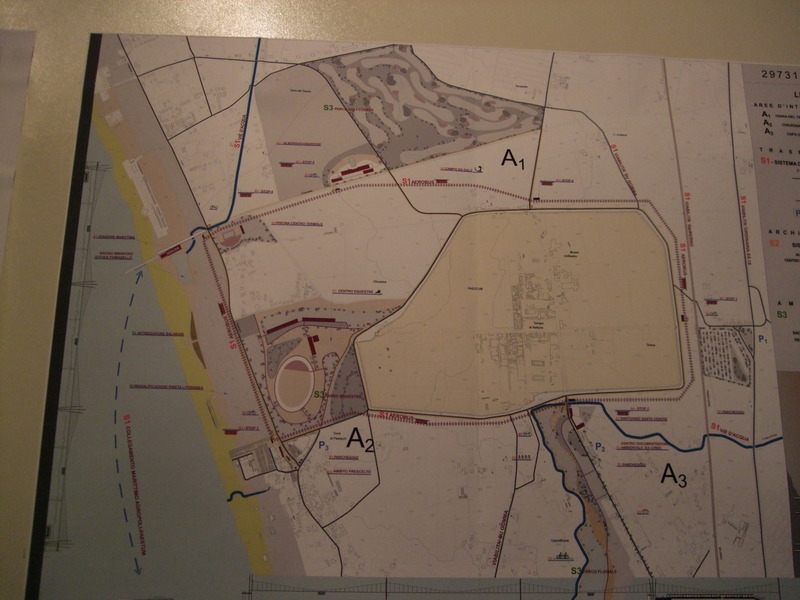
There was also a display which seemed to be proposals for redevelopment of the surrounding ares, which look hideous.  If you want to come, come now!


I have also decided that I don't know enough about Greek or Roman Gods and mythology so have down loaded the Iliad to read - well you've got to start somewhere...

So, this is the most southerly point on this incursion into Italy and we didn't really think to be getting this far by this time.  We are meeting friends for an Italian Lakes break next week and still have to go back to rome so it is time to head back to the frozen north (although it is looking more promising now!

So Carrefour detour - the first one we have actually seen in Italy and we are intrigued as to what carrefour.it will be like - then back to rome by way of St Felice Cicero - well the police have told us where to park now so we should be assured of a quiet night's sleep and no rude awakening at some ungodly hour....